
Ni-MH AAA400mAh 1.2V Rechargeable Battery turnover time:2026-10-19 number of clicks:4次
Part A: Battery Digital Product Information
1. Battery Manufacturer: HUIXIAN SUNRISE POWER SOURCE CO.,LTD
2. Battery Category: Portable Ni-MH Rechargeable Battery (Portable Battery of General Use)
3. Manufacturer Address: West Suokelou, Huqiao, Huixian, Henan, P.R .China
4. Production Address: Huixian, Henan, P.R .China
5. Model Number: Ni-MH AAA 400mAh
6. Batch Number: See Battery
7. Trademark: SUNRISING
8. Web: www.xuridy.com
9. Email: xinzhou@xuridianyuan.com
10. Contact: Zhao WenXuan
11. Date of Manufacture: See Battery
12. Weight: 8.7±0.5g
13. Rated Capacity: 400 mAh /0.48Wh
14. EU Regulation (EU) 2023/1542: The contents of mercury, cadmium and lead in this battery are below the limits laid down in Article 6 of Regulation (EU) 2023/1542 and in Annex I thereto (mercury < 0.0005 %, cadmium < 0.002 %, lead < 0.01 % by weight) -test report No.SZXEC26000039201. Neither the 'Cd' nor the 'Pb' chemical symbol required by Article 13(5) is therefore affixed.
15. Hazardous substances present in the battery other than mercury, cadmium and lead (Annex VI, Part A, point 8): potassium hydroxide (KOH) alkaline electrolyte, corrosive (H314), contained inside the sealed cell, and nickel compounds. No other hazardous substance is present above the applicable thresholds.
16. Chemistry: Ni-MH (Nickel-Metal Hydride)
17. Usable Extinguisher agent: Water spray, carbon dioxide, dry chemical or foam.
18. Critical raw materials present in the battery( If concentration is more than 0.1 % by weight, the critical raw materials being those listed in Annex II to Regulation (EU) 2024/1252): KOH 31.6%;NiOH 20% ;Water 18.3%;FeO 16.7%;LaNi5 8%;NaOH 2.8%;Graphite powder 2.6%.
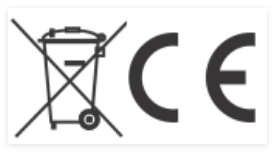
19. Environmental and safety-related icons.
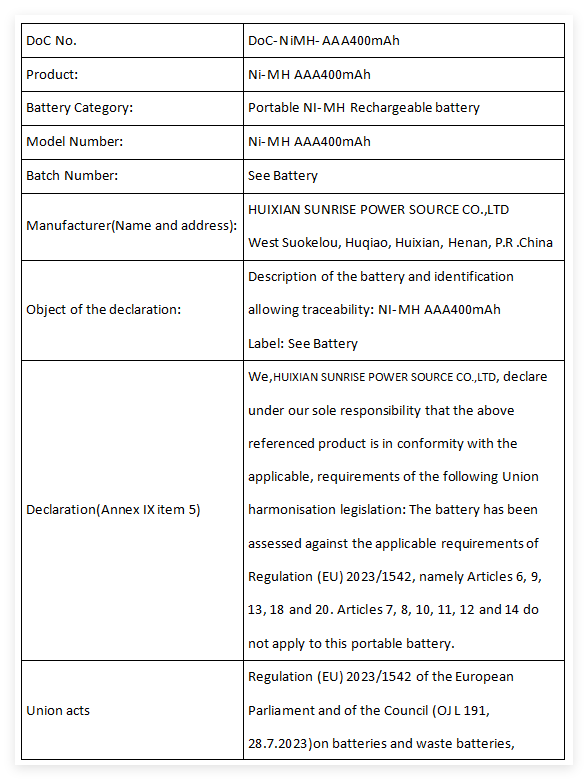
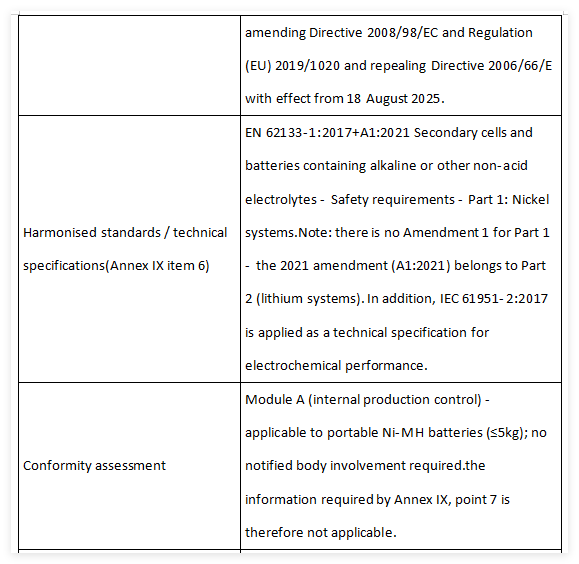
EU Declaration of Conformity
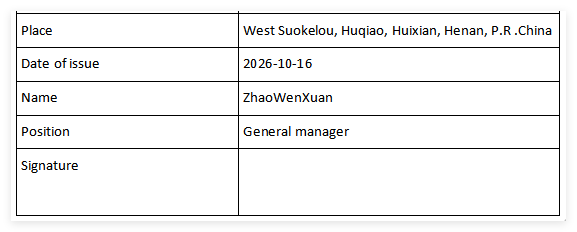
Signed for and on behalf of:
Part C: Information on Prevention and Management of
Waste Rechargeable Ni-MH Batteries
In accordance with Regulation (EU) 2023/1542 and Directive 2008/98/EC (the Waste Framework Directive), battery suppliers shall provide the following information to users and distributors:
(a) Waste Prevention Tips
Use only manufacturer-matched chargers; avoid extreme temperature and humid storage.
Remove batteries from long-idle equipment to prevent over-discharge and swelling.
Hand over expired batteries to designated recycling points for metal recovery; intact cells can be reused for low-power storage.Do not mix new and old batteries.
(b) Separate Collection Rules (Article 74(1), point (b))
Do not discard or indiscriminately pile used nickel-metal hydride (Ni-MH) batteries as ordinary household waste.
Sorting and recycling can recover nickel, rare earth metals, and steel to meet EU environmental standards. Relevant regulations require that batteries must be delivered to designated recycling points and must not be disposed of as ordinary household waste.
(c) Recycling Channels & Treatment
Waste batteries can be returned to retail collection bins, municipal recycling stations and official battery recovery sites.
Collected batteries will be sorted, neutralized and recycled. Functional cells get secondary use; scrapped batteries undergo metallurgical raw material extraction.
(d) Waste Battery Safety Operation
Keep waste batteries away from metal items to avoid short circuit.
Seal leaking, deformed or overheated batteries with gloves in plastic bags.
Never incinerate batteries to prevent explosion and toxic gas release. Keep batteries out of children ’s reach; seek emergency treatment if swallowed.
Do not disassemble the battery.
(e) Marking Explanation (Article 13(4) and (5), and Article 74(1), point (e))
1. Crossed wheeled bin: Must be recycled separately, not mixed with household waste.
2. CE mark: Indicates conformity with the applicable EU safety and environmental requirements under Regulation (EU) 2023/1542 (Articles 19-20). This battery does not require the 'Cd' or the 'Pb' chemical symbol under Article 13(5), because the cadmium content does not exceed 0.002 % and the lead content does not exceed 0.004 % by weight.
(f) Environmental & Health Hazards
Ni-MH batteries contain nickel, rare earth and alkaline electrolyte. Random disposal causes soil and water heavy metal pollution.
Swallowing batteries leads to internal burns; leaking liquid may cause chemical injury. Standard recycling reduces pollution and recycles reusable resources.
This document is provided in accordance with Regulation (EU) 2023/1542 to guide standardized battery use and disposal.
(g) Due diligence Art.52(3):This item is not applicable.The manufacturer's net turnover is below EUR 40 million and it is not part of a group exceeding that threshold on a consolidated basis, so the battery due diligence obligations of Chapter VII of Regulation (EU) 2023/1542 do not apply (Article 47). Where Chapter VII applies, the report referred to in Article 52(3) must be accessible through the QR code (Article 13(6), point (b)).
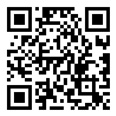
(h) QR code to access the statement: Free QR code scanning with no registration required; links guaranteed valid for at least 10 years; includes update dates; available in local languages for various countries; entry point for battery refurbishment information.In accordance with Article 13(6), point (b), of Regulation (EU) 2023/1542 the QR code gives access to: (i) the general information, the capacity marking and the separate-collection and heavy-metal markings referred to in Article 13(1) to (5); (ii) the EU declaration of conformity referred to in Article 18; (iii) the report on the battery due diligence policy referred to in Article 52(3), where applicable; and (iv) the information on the prevention and management of waste batteries set out in Article 74(1), points (a) to (f). That information is complete, up to date and accurate, and is provided in the language(s) easily understood by end-users in the Member State where the battery is placed on the market.
Previous: Ni-MH AA150mAh 1.2V Rechargeable Battery
 Yugong net anbei 41078202000175